понедельник, 6 декабря 2010 г.

Trains in St. Petersburg

There is a subway system in St. Petersburg, called the metro as in Moscow, but it has a few differences. First of all, there are a lot more signs in English throughout the St. Petersburg metro compared to the one in Moscow, perhaps because St. Petersburg receives more frequent foreign visitors.


After all, since it is a port city there are international cruise lines which make stops in St. Petersburg for a few hours and guests can walk around.  If they don't know Russian they can still get around the metro by reading English.

Another noticeable difference between the metros in St. Petersburg and Moscow is that in the central St. Petersburg stations the tracks are not visible from the platform, has which walls along its edges with doors placed at the spots where the train doors will be. You don't see the trains coming or going, but you can hear them.  The next two photos show what such a station looks like on the platform.


It looks like everyone is waiting to go the bathroom. Here is one of the platform doors which opens when a train arrives.


The reason for this odd method of constructing subway stations, someone told me, is the possibility of floods.  If a flood entered the tunnel then the platform doors would keep the water out of the station.  Or maybe it is a way to make the stations into bomb shelters?

Ads in the escalator tubes of the Moscow metro are on the side walls, but in the St. Petersburg metro the ads are along the centrally lit area between adjacent escalators.


The Moscow metro runs entirely on plastic swipe cards, but in St. Petersburg tokens are still in use (along with swipe cards).  I was surprised when I asked for 4 rides and got 4 tokens instead of a card.

In the next photo are the rules of the Metro.  You must know them to be allowed to ride on the trains.


The weirdest metro station I saw was, without a doubt, Gorkovskaya. It looks like a UFO that has landed:


Its original shape, which was rather boring, can be seen at the Wikipedia page for the station.

In one of the central metro stations I saw an ad for a Hannukah concert:


I arrived and left St. Petersburg from the Moscow rail terminal (all stations are named according to the major city they go to), which on the inside has an impressive wall diagram showing all the rail lines connected to St. Petersburg:


In one of the shops in the station there were some Cheburashkas for sale which appeared Indian:


I waited in the station for the announcement of my train to appear, with its track number, on the large sign below.  (Note 5л and 5п mean different things: 5 left and 5 right.) In the smaller sign on the left is the time and the freezing temperature.


To the right of the big sign were two cigarette ads:


The noticeable thing here, to me, is how non-short their contracted word is for Ministry of Health and Social Development in the bottom of the lower ad: минздравсоцразвития.  That's shorter than writing out all the words, but why not make a truly short version like МЗСP instead?

While I was walking along the platform to my train car to return to Moscow, I passed another train line called "Grand Express" which had fancier overnight train cars: two beds per room.


Below is the cabin I had on my train ride to Moscow, which had 4 beds but there were only three of us there. I took the 4th pillow when the train started moving, but then I got paranoid that a 4th person might arrive in the middle of the ride so I put it back.

St. Petersburg beyond museums

Today I'll show various sites in St. Petersburg which are not museums.

Along Nevsky Prospekt is a church that looks very much like the Vatican: Kazan cathedral.


During communism the Kazan cathedral was a museum of atheism, but it is now again a working religious building. Across the street from the cathedral is the St. Petersburg branch of the Dom Knigi bookstore, whose Moscow branch I had bought North American style erasers in:


The sign above the entrance says "Singer Company": this building was owned by the Singer sewing company before the Russian revolution. Inside the store I discovered that I had been ripped off in a nearby souvenir shop: what I had bought a few minutes earlier at the souvenir shop was on sale at the bookstore for less money.  

Further along the street, at 14 Nevsky Prospekt, is a blue sign left over from the Siege of Leningrad, when the Germans closed off all land routes to the city and attempted to take it over by basically starving everyone inside.  The sign says "Citizens! This side of the street is more dangerous under artillery shelling.''  I wonder if they always make sure there are flowers there.


There is nothing special drawing the pedestrian's attention to the sign, so you could walk right past it and go to a Bosco sports store nearby.


To the left of the artillery sign is an alley that leads into a courtyard where there is a globe:


Here is the globe from two sides, showing a scale model of the last ice age, when the northern hemisphere was covered by snow and ice thousands of miles thick:


In the background of the second photo are a father and son cleaning out a space to play basketball.  Notice the basketball court is basically a carpet, which the father is lifting up.


The son tries to imitate his father by whacking at the court/carpet with a stick.

The ad in the next photo, still on Nevsky Prospekt, is for the Rainbow shopping center. Who knew St. Petersburg had a gay-friendly place to shop?


Often the city name St. Petersburg is abbreviated to SPB (= СПБ).  But one business decided those letters stand for something else: Network of Beer Bars.


A couple of weeks later I found this chain of bars is in Moscow too.

Across the Neva river from the city center is a large mosque, whose construction started 100 years ago:


I first saw this mosque when I visited St. Petersburg in 2004, but I have never seen any people going into or out of it.  Across a park from the mosque is a very small chapel.


This marks the former spot of the first church in St. Petersburg, which the communists knocked down:


Not far from the chapel is a boulder that is a monument to the prisoners of the Gulag. The boulder is from the first Soviet prison camp.


The park containing the boulder and chapel is bounded on one its four sides by an elegant building.  Would you like to live there? It's an institute, so you can't.


More monuments to suffering: below is a memorial to the torpedo boat Strashny, which was sunk by the Japanese in 1904 during the Russo-Japanese war. The monument depicts several sailors unsuccessfully trying to prevent snow from coming into their ship.


The first location developed in St. Petersburg was the Peter and Paul fortress, which today is a complex of different tourist sites.  Here is the main building in the fortress, the Peter and Paul Cathedral, shot with the flash and without one:


Some more evening scenes of the cathedral:


Looking at the fortress from outside:


Here is the Church on Spilled Blood, built on the spot where tsar Alexander II was assassinated.


All the photos shown so far are in spots that are easily accessible by the metro.  The next ones are not: the Mariinsky Theater, which has opera and ballet performances. I was told that a metro line under construction will go out to this part of the city, but after finding the nearest metro station I still had to walk a while to reach the theater, which I shot from two angles:


Across the street from the theater are monuments to Glinka


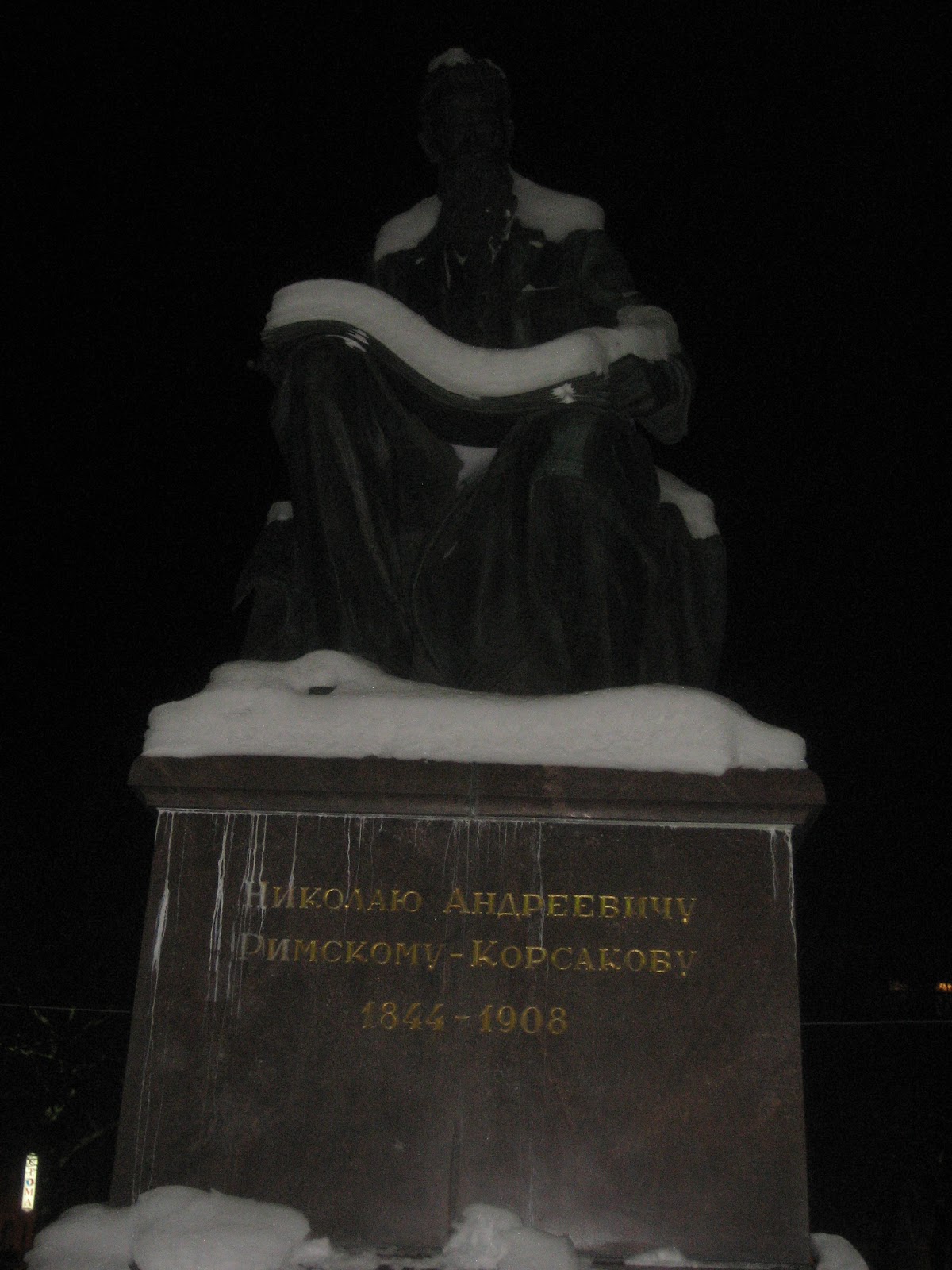
and Rimsky-Korsakov, whose cemetery plot in the winter looks like an outhouse.


After taking these photos of the theater and the monuments I declared "Mission Accomplished" and went back to my hostel, since I had about two hours to catch my train back to Moscow.

One of the ads along the path I walked to reach the Mariinsky theater was promoting an upcoming benefit for childhood cancer and eye diseases:


Among the people who will attend the benefit you can see pictures some of today's hottest celebrities: Melanie Griffith, Kevin Costner, Kurt Russell, Monica Bellucci, and Paul Anka. Wow, Paul Anka!

(Added later:  The benefit has now taken place and Putin took the stage to sing a song in English:


It looks like Paul Anka has nothing to worry about.)


When I took the metro as far as I could to reach the Mariinsky Theater, I was in Sennaya Square. Before I started walking to the theater, I stood near a wall and shot a video of people walking past.  The music playing from the store behind me was all quite non-Russian:


Here is the St. Petersburg branch of the Goethe Institute, which are German cultural and information centers located in many countries:


I asked a German student in the Math in Moscow program about this institute, since I had never heard of it before. He said it was a German attempt to take over the world through friendship, since their first method didn't exactly work out too well.

Walking from the Mariinsky theater back to the city center (and my hostel) along the Moika river embankment, we come to another Mariinsky building: the Mariinsky Palace.


There are still shields with Lenin's face on them across the front of the building (look below the third floor windows in the center). The Mariinsky palace is facing the back of Saint Isaac's Cathedral


which took 40 years to build. During communism there was a museum of atheism here. A walkway outside the cathedral's rotunda offers one of the best spots to get a bird's eye view of the city during the daytime.

пятница, 3 декабря 2010 г.

I see dead people

Last week in St. Peterburg I visited the cemetery at the Alexander Nevsky Monastery and this week I visited the Novodevichy cemetery in Moscow (the second most prominent place for burials after the Kremlin Necropolis, which is currently not taking new customers). There was almost nobody (alive) at either place since who wants to visit anything outdoors at this time of year in Russia?

The cemetery at the Nevsky Monastery in St. Petersburg is quite close to the Alexander Nevsky metro station, which has a mosaic of one of his battles at the top of the escalator:


Here is the pathway to the monastery, with the two parts of the cemetery on either side


the older one called Necropolis of the 18-th century


and the other called Necropolis of the Masters of the Arts:


Euler is buried in the 18-th century cemetery, so that's the one I wanted to see. There is a separate ticket to purchase for each cemetery, and I got charged the foreigner's rate as soon as I opened my mouth (200 rubles, instead of 150). While there is a large map on the wall just inside each cemetery which shows who is buried where, there are also convenient signs if you happen to be looking for Euler:


And here he is, from the front and the back:


At first I was there on my own, but I joined a guided tour in progress to hear what the guide would have to say about Euler. I expected she'd say he was a mathematician and physicist, and not anything more in terms of his work. Much to my surprise the first thing she said about him is that he worked in number theory. I was tempted to ask if she could tell us anything more about that work, but resisted the urge.  The guide said that the St. Petersburg Academy of Sciences paid for the special grave (which is made of a colored stone, unlike other graves) and, perhaps at a loss about what more could be said, pointed out that prominent political and artistic figures are widely known by the public but folks like Euler are really not. With that she moved on.

Here is Lomonosov, whom Moscow State is named after:


The first director of Moscow State is buried under this snow:


Note he died in 1757, so he was hardly a first director for long: the school was founded in 1755.

The first Russian scholar of China, Nikita Bichurin:


One old grave has a tree growing out of it:


When I stepped out of that 18-th century cemetery to go home, a lady at the entrance to the Masters of the Arts cemetery motioned for me to come there too.  I was pretty certain you needed a separate ticket; maybe she thought I was on the guided tour and got lost? In any case I followed the lady's suggestion and saw some Masters of Arts, such as Dostoyevsky


and in the composer's corner (all near each other) is Tchaikovsky


Mussorgsky


Borodin


and Rimsky-Korsakov


which is a grave I had to find by interpolation from the map on the wall. In fact a lot of graves were similarly covered up because of the winter weather. It looked like there were a lot of outhouses all over the place. Here are some more of them:


Unlike these cemeteries in St. Petersburg, the Novdevichy cemetery in Moscow is free to all visitors. It is located next to the Novodevichy convent, which looks as follows if you go there by Metro:


To get to the cemetery you walk towards the tall tower on the left, past it, until you reach a red brick wall and then keep walking until you reach a set of open gates with a big sign. In the cemetery I wanted to see the graves of Arnold (passed away last summer), Kolmogorov, Kantorovich (the economist), and  Pontryagin. However, in that cemetery there are thousands of graves and you need a small book to list  where they are all located. They do sell a map, but of course it is limited to a small number of famous political, artisitic, and military figures. There was an old lady at the map kiosk who offered to take me on a tour for 300 rubles (about $10, so it's free if you just wander aimlessly) and she had a complete directory in book form.  I quickly said yes, and after she found the dead people I came to see she showed me where other notable folks are buried.

Here is Arnold, who is still waiting to get a gravestone.  To his left is the physicist Ginzburg.


And next we have Kolmogorov


Kantorovich (whose gravestone looks like something is missing)


and Pontryagin:


Initially my guide looked through her book and told me Pontryagin was not there.  I insisted he was, although saying "I saw it on the Internet" isn't really a guarantee of anything.  She still said the name wasn't in her book, but when I gave his full name she found it. The last name had been misprinted:  Пантрягин instead of Понтрягин.

Two other mathematicians buried here are the bald number theorist I. M. Vinogradov


and the long-time rector of Moscow State, Petrosvsky,


whose gravestone has a tensor transformation law on it.

The mysterious Lada Pyshkina (does anyone know who she was?) has a golden spiral on her grave


Some physicists there besides Ginzburg are Landau


and Kapitsa:


The inventor of the modern parachute, Kotelnikov, has a grave with a big parachute on it.


Musicians include Shostakovich


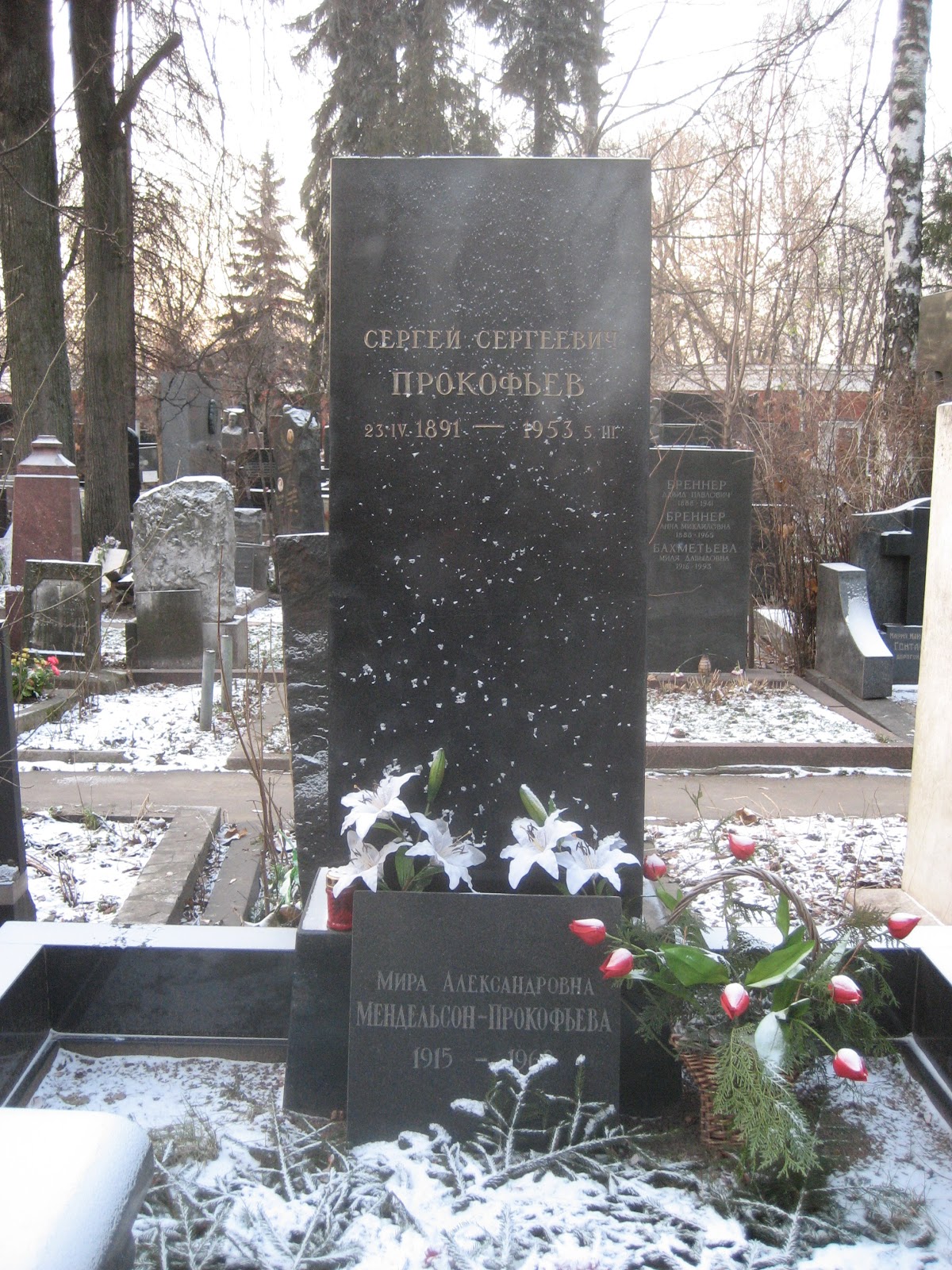
and Prokofiev,


who had the unfortunate timing to die on the exact same day as Stalin, so few people noticed. (The Wikipedia link for Prokofiev discusses this point some more. Another example of someone who died on a day someone far more famous died is here.)  While Tchaikovsky is buried up in St. Peterburg, his brother the engineer is in a covered grave in Moscow:


Writers here include Chekhov


and Bulgakov:


In acting there is Stanislavski


and Nikulin


who at the end of his life was in charge of a circus. My guide said that for good luck people brush their hand on either of the ears of that dog.  This is more painful in winter than in summer.

Some people related to politics in the cemetery are Stalin's second wife (the first wife is buried in Georgia)


 Yeltsin under an enormous tricolor stone flag


Raisa Gorbachev


and the future site of Mikhail Gorbachev


to his wife's right (or left, depending on your point of view).  My guide told me that the Gorbachev grave plot is where Yeltsin had wanted to be buried, but Gorbachev's wife beat him to it by dying first. Another politician there is Gromyko


whose grave has a positive and negative image in it.  Here is the negative image on closer inspection:


Finally, here is (according to my guide) the oldest grave in the cemetery:


I of course asked the guide where the second oldest grave is. She wasn't sure.

Unfortunately I can't tell you where almost any of these graves are located in the cemetery since I didn't see any numerical markers of rows to help out (I wonder what was in the directory my guide was using).  But I do remember that if you walk straight ahead through the entrance you will see Yeltsin's grave some distance down on the left and its size and colors make it quite noticeable.  Nikulin's grave is in the same general area, but along a path on the right.

Many of the graves have flowers.  Who is ordering these flowers?  The guide said that, at least for all the  military graves, the flowers are paid for by the Defense Ministry, which puts them up on birthdays or other important occasions.

The cemetery was undergoing a lot of repairs the day I was there


so many of the paths were closed off.  Even paths that were open were partly stone and partly dirt:


At first I thought the barrier at the end of the stone path above would have a sign on the other side warning people about the rough dirt terrain ahead, but in fact it said nothing:


You just need to watch where you're walking.